

Ogrzewanie podłogowe na płycie wiórowej MFP
When planning a home renovation or a timber-frame construction project, we often face a challenge: how to install an efficient heating system without overloading the ceiling? The answer is a dry system, in which underfloor heating on an MFP board plays a key role. This solution combines lightweight construction with excellent insulation and mechanical parameters.
Why is MFP chipboard the foundation of success?
Traditional underfloor heating embedded in a concrete screed has its advantages, but its weight (up to 130 kg/m²) excludes it from many renovation projects. Underfloor heating on chipboard (usually 22 mm or 25 mm thick) allows for installation with a weight reduction of nearly 90%.
Kluczowe właściwości płyty MFP w systemach grzewczych:
-
Homogeneous structure: Unlike standard chipboard, MFP has the same strength at every point, which is crucial when milling channels for pipes.
-
Moisture resistance: The MFP board has a higher diffusion resistance coefficient, which protects the structure against possible condensation.
-
Dimensional stability: The board does not undergo significant deformation under the influence of temperature changes (heating cycles).
Step-by-step installation: MFP chipboard for underfloor heating
The dry installation process differs from traditional wet methods. It requires precise substrate preparation and careful planning of the heating loops.
1. Preparing the base
The panels are laid on a stable joist structure or directly on an existing, level subfloor. It’s important to maintain perimeter expansion joints, which allow the floor to “flex.”
2. Milling channels
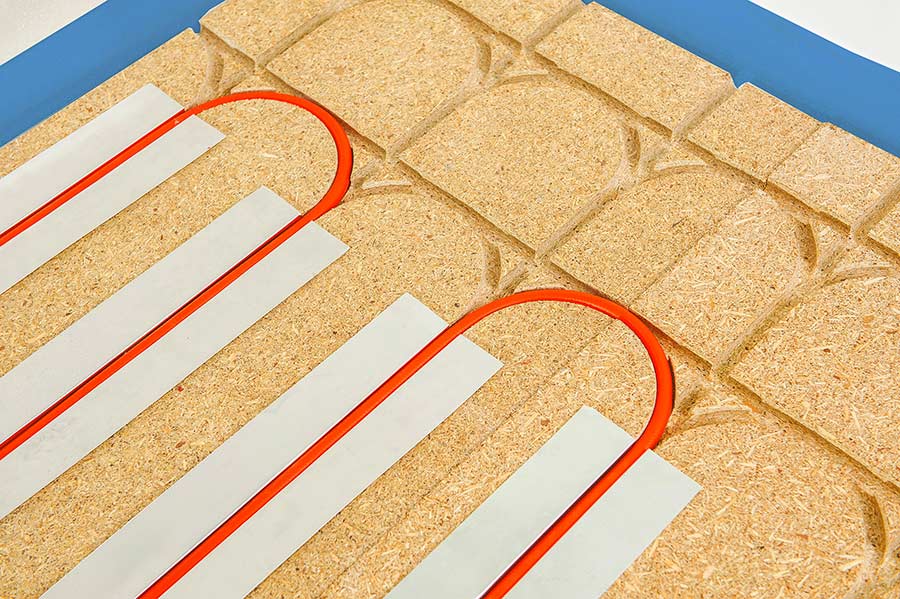
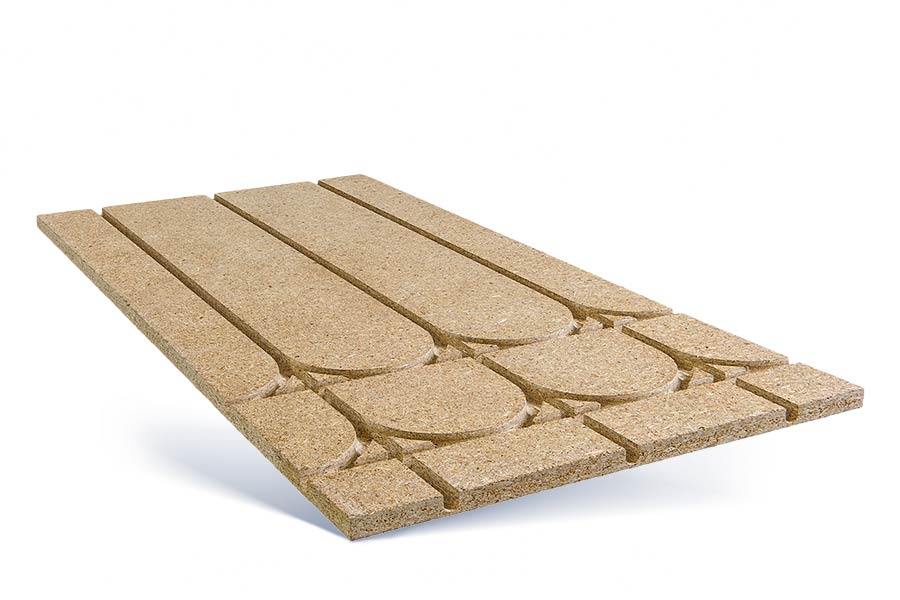
Precision milling cutters (grooves) are made in MFP boards, in which heating pipes (usually 16 mm in diameter) will be placed.
Important note: You can purchase ready-made boards with factory-made cutters, which significantly speeds up assembly work and minimizes the risk of damaging the board structure.
3. Heat distribution – transmission plates
Because wood and wood-based materials are insulators, aluminum profiles (lamellas) are necessary. These profiles absorb heat from the pipes and transfer it to the entire floor surface.
4. Surface finishing
On the structure prepared in this way you can place:
-
Floor panels (with appropriate heating certificate).
-
Ceramic tiles (require an additional layer of compensation mat or gypsum fiberboard).
Advantages and limitations of the dry system
Each technology has its own specifications. When choosing MFP underfloor heating, it’s worth knowing both its strengths and weaknesses.
Summary: Is it worth it?
The use of MFP chipboard for underfloor heating is a rational choice wherever time and lightness of construction are important. This solution is especially recommended in wooden buildings, attics and when renovating old tenement houses. Thanks to the high density of the MFP board, this system is durable and ensures thermal comfort for years.

